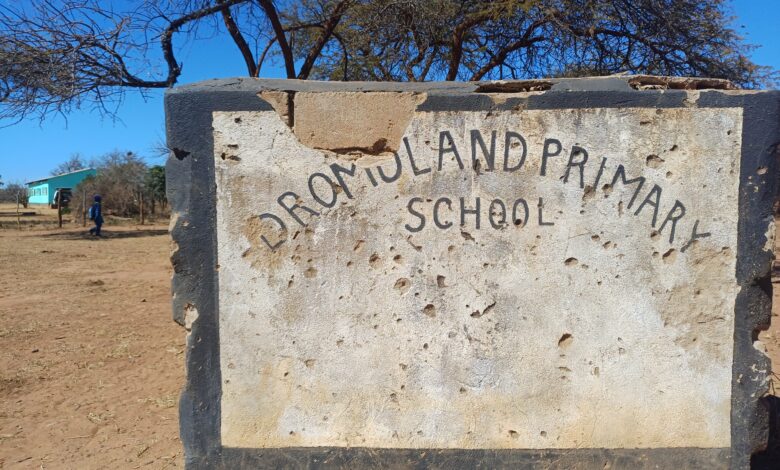
Dromoland Primary School Feeding Program lifts learner welfare, reduces household expenses; says parents
By Sihlobo Bulala
Parents of children attending Dromoland Primary School in Bubi District, Matabeleland North, have praised an ongoing school feeding program, saying it has significantly improved their children’s learning environment while easing the burden of daily household expenses.
The school feeding program is being implemented in Bubi, Umguza and Nkayi districts by ORAP, with support from Mary’s Meals International (MMI) and working in partnership with the Ministry of Primary and Secondary Education. The program is targeting primary school children with fortified Corn Soya Blend (CSB) prepared on site and is currently reaching 171 schools with over 79000 learners receiving a meal every day at their place of education.
Nonhlanhla Ngwabi, a Dromoland Village 8C resident in Ward 12, shared that as the program has greatly benefitted her children attending their education at the school, it has also reduced their household expenses.
“We used to prepare at least four meals for our children, which we meant for them to have in the morning, in the afternoon, in the evening after school, including some of which they carried to school in their lunchtins,” she said.
“I have however realized a change since the feeding program started because now when packing food for them, they advise me to reduce the portions as their stomachs are filled by the porridge they are having at school. Sometimes, even when there is nothing at home, they don’t decide to skip going to school as they say that they will get something to eat there,” she added.
“Since the feeding program started, we have also had some strength and confidence when searching for money, knowing that you’re focusing on looking for the school fees and not so much about food. Our budgets are now a bit manageable, and there is no longer too much stress related to wondering what the children will eat when they come back from school, or wondering what they will carry to school,” she said.
The Field Officer for the Schools Feeding Program in Bubi District, Siphethokuhle Ngwenya, shared that as one of the schools she is monitoring, Dromoland Primary School has experienced an increase in the enrolment of children in the school as the feeding program continues to impact the community.
“When the program started in 2022, the school enrolment was low, and it has now increased. Even absenteeism has reduced. This program has brought change in the community because our area is affected by low rainfall, affecting the availability of food. What I saw is that as we started, there weren’t many children at school as they were dropping out, but as we started that’s when we started seeing other children beginning to attend. It’s now better for children who would have left home without eating and even those who won’t be carrying anything to eat are no longer left out as there is now uniformity in the school,” she said.
Felicity Read, Director of Communications of Mary’s Meals International, shared that having a nutritious meal at school is important for the learners as it gives them the motivation necessary to stay ahead.
“Having a nutritious meal at school gives learners the energy to concentrate on their lessons, and when they can concentrate and focus on their learning, a by-product of that is that their marks go up. We hope that as many of them are motivated to stay in school until grade seven, they are then motivated to go into secondary school so that they can benefit from quality education and contribute to society when they are an adult,” she said.
Nozibusiso Hlabangane, another resident of Dromoland Village 8C, emphasized the need for additional support programs to complement the school feeding initiative. While the feeding program has helped retain some learners, she noted that several children in her community are forced to drop out due to the ongoing financial challenges faced by families.
“I have a child who is supposed to be in form one this year but stopped after grade seven. I think there are many other children who are now at home and could be helped by handiwork skills like woodwork because being idle at home can cause them to adopt dangerous thoughts as they will now be seeing themselves as adults. It’s not that they are failures, it’s only that there haven’t been such kind of programs that can expose us to what they are good at and what can sustain their livelihoods in the long run,” said Hlabangane.
The two women, Nonhlanhla Ngwabi and Nozibusiso Hlabangane are also part of the volunteering school feeding program committee after the decision taken by the community to ensure that the feeding program maintains the same standard and can in turn retain and increase the number of children partaking in the initiative.
“We decided to volunteer because we saw that this initiative is here to help our children. In as much as it is directly impacting our children who are now happy, we are also benefitting as a certain portion of the burden we experience as parents has been lifted,” they said.
The school feeding program is in line with the Zimbabwe School Health Policy (ZSHP) which supports the implementation of a number of health-related issues relating to the welfare of learners in the school system, including health and nutrition services.