Bulawayo residents demand enforcement of anti-corruption laws
By Sihlobo Bulala
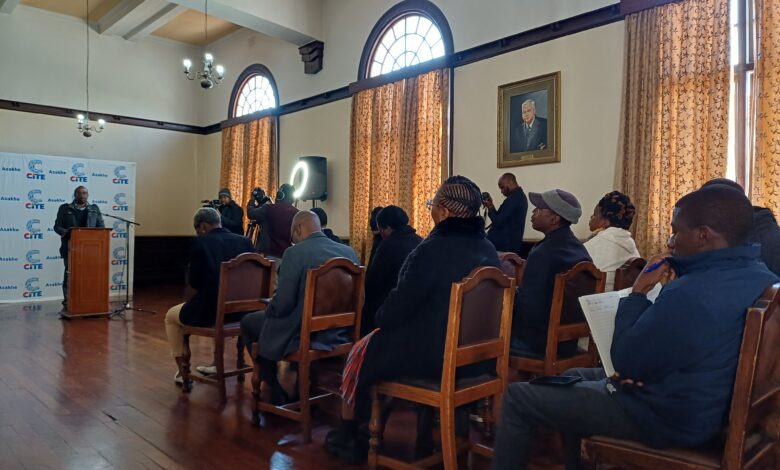
Bulawayo residents are demanding that individuals implicated in local government corruption be held accountable and face legal consequences. This call for action was vocalized during a public policy dialogue event organized by the Centre for Innovation and Technology (CITE), Bulawayo Progressive Residents Association (BUPRA), and the Public Policy and Research Institute of Zimbabwe (PPRIZ), yesterday.
The public dialogue, which brought together various stakeholders including residents, civil society leaders, councillors, and business representatives to address challenges and explore solutions for a more transparent local government revealed a growing lack of confidence in the council’s ability to address corruption. The skepticism stems from the residents’ perception of impunity and their growing demand for tangible action against those who exploit public resources.
Speaking during the event, a resident from Mpopoma, Makhosi Sibanda highlighted that corruption is now a pandemic in Bulawayo and wondered if the city council is intentional about fighting it, and if they have effective relations with anti-corruption institutions like the Zimbabwe Anti-Corruption Commission (ZACC), National Prosecuting Authority of Zimbabwe (NPAZ), and the Zimbabwe Republic Police (ZRP).
“You’re talking about how there is too much corruption but we haven’t seen one person being arrested. If you’re intentional about ending corruption in Bulawayo, you would have come here to tell us how many people you have arrested in 2025, and how many you intend to bring to account in 2026, that way there would be measurable progress towards ending corruption,” he said, addressing his comments to city council representatives.
Another resident, Thabani Mlotshwa, concurred with the sentiment that corruption is now a pandemic as also demonstrated by the actions of guest Deputy Mayor Edwin Ndlovu, who in absentia was represented by Ward 2 Councillor Adrian Rendani Moyo.
“That is the first corruption that is there in the council. These are the people who run around during electioneering time, wanting to be voted for. They promise this, they promise that but now he decides to send someone to read on his behalf. He doesn’t want to listen to the stakeholders. So, let’s take note of that residents, let’s get rid of people who have no people at heart,” he said.
Mlotshwa further disagreed with the idea that promoting and having pride in the city’s cultural values will help curb corruption.
“Let’s stop this thing about culture, to continue saying that we have our own culture. There is no culture left here. The arm of law must take its course. People should be arrested. Why are you not working with ZRP to get people arrested? Let’s not rely on Ubuntu anymore because Ubuntu is no longer there,” he said.
Zimbabwe has a comprehensive legal framework aimed at combating corruption, including the Constitution, the Anti-Corruption Commission Act, and the Criminal Law (Codification and Reform) Act, and key institutions such as the Zimbabwe Anti-Corruption Commission (ZACC), and the National Prosecuting Authority of Zimbabwe (NPAZ). However, challenges remain in effectively implementing the laws and addressing the prevalence of corruption in both the public and private sectors.
Speaking during the event, Zibusiso J Dube, PRRIZ research fellow shared that corruption is now a widespread phenomenon that has become normalised and needs to be dealt with because it affects communities in many ways.
“Corruption is often a challenge of accountability and transparency. It often happens because there are opportunities for it to happen and because our oversight mechanisms are weak. Part of fighting corruption is the need to be aware of the corruption dynamics that are at play so that we develop policies that remove reasonable reasons for people to engage in corruption,” he said as he explained that a common example of reasonable corruption is the bribery that occurs in the attainment of driver’s licenses, as without paying there is no way to get the service.
During the discussions, Sizo Sithole, the Acting Director of the Internal Audit and Risk Management Department at the Bulawayo City Council (BCC) shared that there are various mechanisms which the city has established to address corruption. These include the incorporation of four professional internal auditors whose main function include looking at operations within the city, especially those that are susceptible and prone to corruption, like procurement. More so, Sithole further highlighted that there are policies that are in place to curb corruption like the Fraud, Waste and Abuse policy, by-laws, and they work closely with ZACC and ZRP during investigations.
“Currently, we are in the process of establishing one mechanism which we think will be effective in terms of fighting corruption, which is the establishment of a fraud hotline. It is one mechanism we believe will make it easier for residents and stakeholders to report corrupt acts that they witness being committed by employees of the city, management, or even policy makers,” he said.
Deputy Mayo, Cllr Edwin Ndlovu represented by Cllr Adrian Rendani Moyo acknowledged the importance of integrity and the effects that are often realized if integrity is non-existent in local governance.
“Without integrity, trust between citizens and the state erodes and once that trust is broke, it becomes increasingly difficult to implement policies, mobilize community action, or achieve any meaningful transformation,” he said.