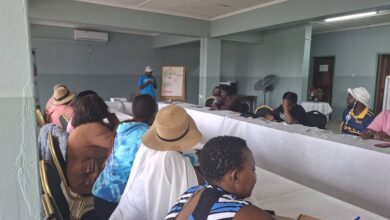
Bulawayo media practitioners trained to tackle AI disinformation and improve news production

By Nobukhosi Ndlovu
Media practitioners in Bulawayo came together for a specialised training programme recently aimed at protecting the integrity of local news in the age of artificial intelligence.
As the AI technology continues to transform communication around the world, Bulawayo’s media sector took steps to ensure that it is not left behind.
Through initiatives like Ai powered disinformation training, local journalists were working to make sure that new technologies are used to strengthen rather than weaken public trust in the news.
The workshop that was led by National University of Science and Technology, was conducted by the university’s Media Department in partnership with Fojo Media Institute.
The initiative was designed to help journalists understand and respond to the growing risks posed by AI-generated misinformation.
“It is high time we start those honest conversation in terms of what we need to be on the lookout for, what we need to embrace and what we need to throw away.” Nkosana Dube, the Chairperson of the NUST Department of Journalism and Media Studies said in his address. “What remains is that, Ai is here to stay, whether we like it or not but it is here to stay. So we decide whether we want to embrace it or not,” he added.
Dube even explained to the participants that also in the adoption of Ai tools, users have to stay true to the fundamental principles of ethical guidances of journalists. “We need to be asking ourselves the kind of journalism we aspire to see in Zimbabwe and Africa,” he advised.
“A stronger journalism is a stronger society,” Dube pointed out, explaining the importance of accountability within the media sector, highlighting how it strengthens the function of media.
In an era where computer systems can confidently present false information as fact, media experts highlighted that the training was meant to act as a digital empowering platform, ensuring that local newsrooms remain productive and reliable sources of information for the community.
One of the key issues addressed during the sessions was the concept of AI “hallucinations,” when an artificial intelligence system produces information that is incorrect or completely made up, yet presents it with certainty.
“Ai is supposed to be a copilot,” Sean Ndlovu, the training facilitator and a media consultant shared, guiding participants through both the risks and the practical uses of AI tools in the newsroom.
Ndlovu took the participants through a series of Ai tools, explaining their function and how to better utilize the tools to automate tasks. He discouraged against heavy reliance on them.
Rather than focusing only on theory, the workshop included hands-on sessions where participants were learning how to use AI-powered visual creation tools to produce graphics and social media content.
This is expected to help newsrooms streamline their production workflows while maintaining accuracy and professional standards.
Organisers say the goal is not to reject artificial intelligence, but to teach journalists how to use it responsibly. By understanding the biases and limitations built into these tools, media professionals can avoid publishing misleading or distorted information.
The programme also highlighted a broader shift in how journalism is evolving and how newsrooms are now required not only to report the news, but also to understand the technology that shapes how information is created, shared and consumed.
Community Podium is the recipient of the 2025 Outstanding NGO Reporting Award. This reflects our dedication to amplifying community voices and advancing public-interest journalism.