Binga stakeholders urged to blend indigenous knowledge with science for climate resilience
By Ibin Munsaka
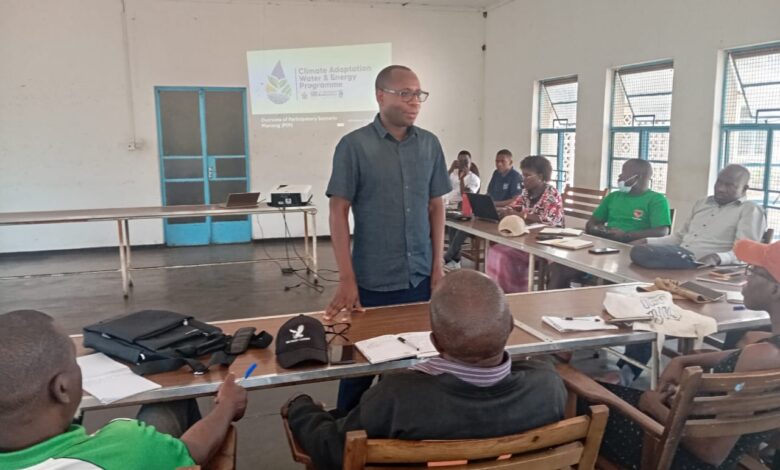
Binga stakeholders recently participated in a two-day Participatory Scenario Planning (PSP) Workshop that is part of the UNDP-CAWEP (Climate Adaptation Water and Energy Programme) initiative aimed at building institutional capacity within local government institutions for effective participatory scenario planning. CAWEP is a resilience-building project designed to strengthen local institutions’ capacity to enable informed planning and decision-making.
The objectives of the workshop were to assist communities and local governments in agreeing on options, making decisions, and developing plans for climate-resilient livelihoods. This involves understanding forecasts and probabilities to manage climatic risks and integrating traditional forecasting with scientific methods to produce localized and accurate weather predictions.
The project intends to support participatory scenario planning (PSP) sessions for forecasting, planning, and improving climate information sharing. The PSP method creates a space for meteorologists, community members, local government departments, and NGOs to share scientific and traditional local knowledge, combining these into locally relevant and useful information.
Fanuel Mudimba, a forecaster from Siansali Ward 15, stated, “Before the inception of the meteorological services department (MSD) that uses scientific methods to predict the weather, we relied on our own indigenous methods to forecast.”
Another forecaster from Siachilaba Ward 10, Robert Sitilo, shared his insights: “In our ward, when it is close to the farming season, around October, there’s a round stone that rolls from under a tree to a nearby small pool and then rolls back again to its usual place. This signifies that we will receive adequate rainfall that season. These are some of the indigenous knowledge systems we utilize before receiving scientific forecasts from the meteorological services department,” he said.
Mrs. Tendayi Msasa, the extension officer for Saba Ward 13, also contributed by sharing that indigenous knowledge systems played a pivotal role in helping farmers predict the rainfall season before the Meteorological Services Department (MSD) introduced its scientific approaches.
“Farmers relied on signs such as animal behaviors, plant indicators, and astronomical observations to forecast the weather,” Mrs. Msasa noted.
Mr. Gift Muripo, an officer and workshop facilitator from UNDP, thanked the attendees for their full participation and encouraged them to continue using indigenous knowledge systems even after the UNDP project concludes. He highlighted that the use of indigenous knowledge is crucial, as it helps farmers plan accordingly.
“The integration of indigenous knowledge systems with scientific methodologies represents a significant advancement in climate resilience efforts. By combining local insights with scientific forecasts, communities can develop more nuanced and effective strategies for managing climatic risks,” he said.
This collaborative approach not only empowers local stakeholders but also enhances the accuracy and relevance of climate information, ultimately fostering sustainable livelihoods and adaptive capacity in vulnerable regions. As we move forward, it is essential to sustain this synergy, ensuring that both traditional and scientific knowledge inform future climate resilience initiatives.