Agroecology: A pathway to just and sustainable food systems
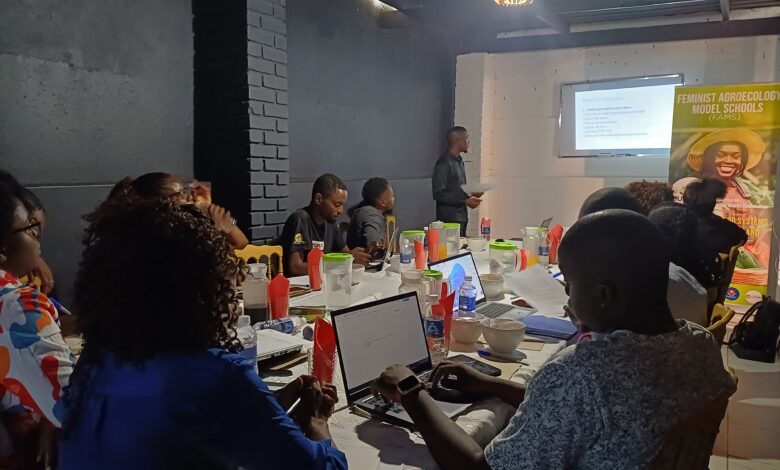
Partner organisations during launch of the Feminist Agroecology Model Schools (FAMS) project
By Sihlobo Bulala
Agroecology has emerged as a promising solution for ecological sustainability while promoting social justice and equity within food systems, with local organisations like the Food Justice Network at the forefront of promoting its adoption by grassroots communities.
Favored for its cross-sectional nature, agroecology integrates diverse fields such as agriculture, ecology, economics, and social sciences to create holistic and inclusive food systems that local communities and underrepresented groups can benefit from. In this manner, it presents an opportunity to tackle intersecting challenges of climate vulnerability, food systems fragility, and social inequality that disproportionately affect women and girls across Africa.
Recently, the Food Justice Network (FJN) in Zimbabwe launched the Feminist Agroecology Model Schools (FAMS) project, a feminist agroecology approach that recognizes the transformative power of women and girls as central actors in building sustainable, resilient, and equitable food systems. The project, which will be implemented through a two-tiered approach, focusing on transforming agricultural practices into agroecology through practical demonstrations while also interrogating policies hindering this transition and advocating for policy changes will be implemented in partnership with grassroots organisations across Zimbabwe.
In an interview with the Food Justice Network Coordinator, Roselily Ushewokunze, she highlighted that the FAMS project is a people-centric project whose success will be achieved through collaborative efforts.
“The project recognises that frontline communities are faced with two critical challenges, which are lack of food sovereignty and the brutal impacts of climate change. It answers the questions, ‘How best can we be food sovereign whilst working towards the attainment of climate justice? What are we going to do? Who are we going to engage in order to achieve this?”
“The project recognises the common struggles of frontline communities and yet, it does not impose on solutions thereby allowing frontline communities to work together but in a manner that works for each of them,” she said.
FJN is firmly rooted in movement building and the power of collective effort to address day to day challenges experienced by local communities, a strategy they have decided to employ for the success of the FAMS project.
“Many a times, grassroot organisations often face homogeneous challenges of limited support, disjointed efforts, and limited visibility whilst pushing for the same transformation. Movement building especially with grassroot organisations is transformative because it allows partners to harness capabilities, synergize, learn, co-create knowledge, and work collectively to break systemic challenges,” the FJN Coordinator added.
Among partner organisations working alongside Food Justice Network is Zion City Foundation, a Victoria Falls based non-profit organisation dedicated to empowering youths through educational support, leadership development, skills training, and psychosocial support.
Procedure Chikosi, Co-Founder and Director of Zion City Foundation, highlighted that the FAMS project they will be implementing at Mvuthu BH 11 in partnership with FJN will address critical community needs including food insecurity, youth unemployment, malnutrition, and the impact of climate change.
“Through training in drought-resistant crops and seed sovereignty, young women will become more climate-aware and equipped to practice sustainable agriculture using climate-smart strategies. This approach will not only enhance resilience to climate shocks but also empower women to manage local food systems and control household nutrition, reducing hunger, poverty, and gender-based violence.”
One of the foreseen impacts that the FAMS project will be able to bring is its ability to feed into the programming that ZCF is already implementing as an organisation, encouraging innovation of cross-cutting solutions that can ensure the sustainability of the project.
“Additionally, the integration of agroecology into community life will provide vital nutritional support for children in our Early Childhood Development program, ensuring they grow up healthy and strong despite the ongoing climate crisis,” she added.
The FAMS project takes off with an ambitious objective to demonstrate the viability and replicability of the agroecology model as a sustainable alternative to industrial food systems and to increase the adaptive capacity of grassroots communities to climate change. Working with partner organisations including Zion City Foundation, Chipochashe Junior School, Matobo Youth Development Initiative, and Young Achievers, the project funded by Climate Works Foundation and hosted by the African Climate Foundation aims to build a strong African movement of food systems changemakers.