Mat-South farmers turn to traditional seed banks to safeguard future harvests
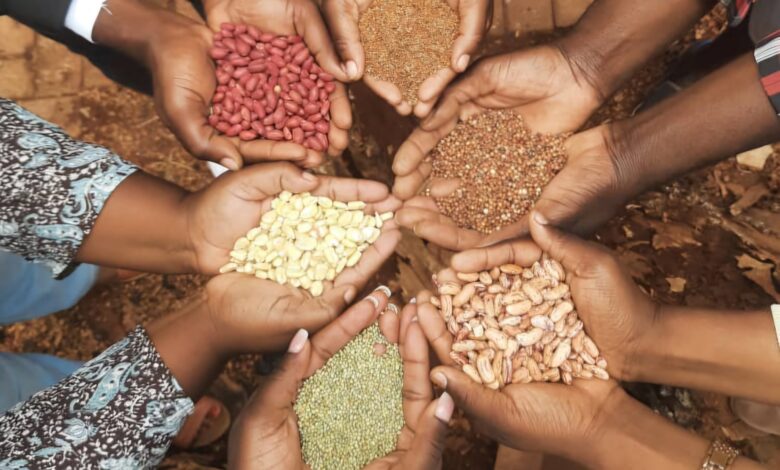
Image Source: Food Justice Network
By Jonah B Moyo
In rural Matabeleland South Province, community seed banks are emerging as beacons of hope for smallholder farmers, promoting crop resilience in the face of climate uncertainty and restrictive policies.
Community Seed Banks (CSBs) are local initiatives where farmers collect, conserve, and exchange seeds of various crop species stored from the previous season. These banks play a vital role in preserving biodiversity and promoting resilience in agriculture.
With CSBs, farmers gain sovereignty over their seed choices, selecting varieties that can thrive in harsh climate conditions. They rely on these banks to access resilient seeds stored from previous seasons knowing they will perform well in their specific soil types, ultimately enhancing their ability to adapt to climate change.
In a recent interview, Lushongwe West Senior Sabhuku Dumisani Nyathi emphasized the importance of seed banks, stating that they are the best source of seeds for local farmers.
“We save seeds from the previous farming season, selecting those from crops that thrived in harsh conditions and produced the best yields. These seeds are stored in traditional seed banks for future use, helping us adapt to challenging environments.
“Our reliance on traditional seed banks has proven effective, as these seeds have shown resilience in harsh conditions. We are focusing on saving small grain seeds like sorghum, which outperform maize in difficult environments and mature quickly, ensuring better yields and food security,”
Sabhuku said.
Nyathi highlighted that seed banking gives farmers sovereignty over their seeds.
“With traditional seed banking, we have control over our seeds, deciding when and how to plant them. This autonomy empowers us to make informed choices, unlike relying on external seed sources where others dictate planting schedules and methods.”
“We adapt to the seasons, planting groundnuts during the rainy period and watermelon seeds when the ground it dry. Having control over our seeds allows us to make informed decisions and optimize crop growth based on weather conditions,” he said.
He stated that they also get seed support from the government.
“We also get seeds from the government to help us grow advanced varieties that can withstand harsh conditions. These seeds do not come in large quantities. Sometimes we get 2kgs of maize and other seeds for our irrigations but these seeds are not enough for farmers, they can’t sustain them as our farms are big, hence why we mostly rely on seeed banking,” Nyathi added.
Lucy Mlilo, a local farmer from Lushongwe, shared that they employ traditional methods to protect their preserved seeds from insect damage, showcasing resourceful and time-tested techniques for seed preservation.
“We rely on traditional methods, such as using ashes, to protect our seeds from insects and deterioration. These techniques are passed down through generations, allowing us to preserve our seeds without using chemical products.
“Our seed banking system allows us to store large quantities of seeds, up to 100kgs, which we can then share with fellow farmers who may be in need, fostering a sense of community and cooperation,” she said.
She also stated that they exchange seeds with the local farmers.
“We practice seed exchange with other farmers, swapping sorghum seeds for groundnut seeds or other crops, promoting diversity and mutual support within our farming community,” Mlilo said.
Bhekilizwe Ncube, Matabeleland South Province Agritex Acting Deputy Director, emphasized the importance of traditional seed banks while highlighting challenges posed by modern policies.
“Farmers continue to save and exchange seeds through community seed banks and seed fairs. These practices are vital for preserving biodiversity. However, they face challenges from modern agricultural policies favouring certified seeds.
“Farmers struggle with limited access to quality indigenous seeds, lack of formal recognition for traditional varieties, and competition from commercial seed companies. Regulatory barriers and insufficient support for local seed systems affects use of these traditional practices,” Ncube said.
“Many farmers feel that commercial seeds and GMOs threaten their autonomy and resilience, as these often require specific inputs and may not be well-suited to local conditions. There is a preference for traditional varieties that are more adaptable and sustainable,” he added.
Ncube highlighted that traditional seed banks seeds are to be exchanged within a 10km radius.
“The Zimbabwe’s Seed Act permits farmers to save and exchange seeds locally but restricts sales beyond a 10 km radius. The Plant Breeders’ Rights Act allows smallholders (farming under 10 hectares and earning 80% of income from agriculture) to multiply and exchange seeds,” he said.
The Plant Breeders Rights Act and the Seed Act have been criticised for limiting smallholder farmers’ ability to sell and exchange their own seeds by favouring commercial seed systems and stifling the autonomy local markets.
Ncube highlighted that farmers are advocating for policies that will promote seed sovereignty.
“Farmers and grassroots organizations are advocating for policies that recognize and support farmer-managed seed systems, simplify registration processes for traditional varieties, and promote agroecological practices. They seek greater government support for community seed banks and protection against the dominance of commercial seed entities. Traditional or local seed systems should be recognized and hence this will offer farmer seed and food sovereignty,” he said.