Umzingwane farmer prepares five plots under Pfumvudza/ Intwasa programme
By Jonah B Moyo
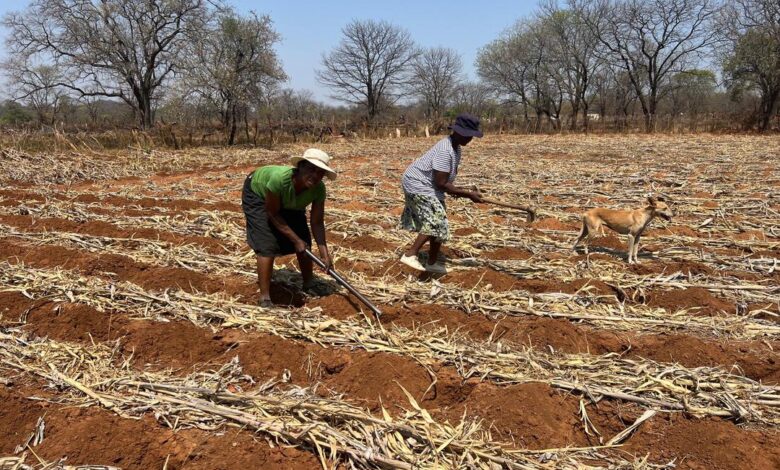
Umzingwane District farmer in Matabeleland South, Ms Patricia Ncube in Irrisvale has prepared five plots under the Pfumvudza/ Intwasa programme which she plans to dedicate to the cultivation of traditional grains.
Pfumvudza/Intwasa adopts a holistic farming approach, transitioning from traditional rain-fed and large-scale ploughing methods to a precise, intensive, and conservation-oriented model that promotes sustainable agriculture.
Ncube began preparing her plots in April, leveraging the favorable moist conditions. She credited various techniques she’s adopted for contributing to her consistently good harvests over the years.
With her proficient farming skills, Ms. Ncube has been able to generate income from her climate-smart farming activities, enabling her to invest in livestock, including goats and chickens, while also supporting her family’s livelihood.
Pfumvudza/Intwasa has played a crucial role in averting food shortages during Zimbabwe’s recent droughts, earning recognition as a cornerstone of the country’s national food security strategy.
While it has its challenges, its core principles of conservation agriculture are sound and have proven effective for small-scale farmers.
“I have prepared five plots under the Pfumvudza/Intwasa programme and await the rains to start planting. Given the dry conditions in my area, I began digging holes in April to capitalise on the residual moisture. Although I had not completed harvesting, I dug basins between the previous crop, which proved beneficial. The soil type is challenging to dig through now, but early preparation has given me a head start.
“I didn’t remove the stover from the last cropping season so I just crushed it so that I can use it as mulch for this season. Farming the Pfumvudza way has really worked for me. I have been farming the Pfumvudza way for seven years and I have been able to acquire assets and to even fend for my family,” she said.
Ncube also adopted the ripping method in a section of her field, which helps retain soil moisture.
She plans to plant groundnuts and small grains, utilizing the groundnuts as a live mulch to benefit the small grains. According to her, other effective live mulch crops include pumpkins, melons, African peas, and more.
She noted that live mulch crops play a crucial role in preserving soil moisture, thereby supporting the overall health and resilience of the crops.
Ncube said she is looking forward to recording a good yield this year as experts have assured of a good rainfall season.
Matabeleland South provincial Agriculture Advisory and Rural Development Services (Aards) Director Mrs Shupikai Sibanda said over 200 000 plots have been prepared in the province out of a target of 500 000.
She said agricultural advisors are working closely with farmers to accelerate land preparation.
Farmers are being encouraged to prepare five plots- two for cereal, one for oil seed and two for fodder.
“Ncube’s initiative is commendable, having prepared five plots and secured mulch. This exemplary approach sets a positive precedent for our farmers in Matabeleland South. We are aiming for 500,000 Pfumvudza plots province-wide, and with over 200,000 plots (approximately 12,000 hectares) already established, we are making steady progress toward our target.
“We urge farmers to prepare for the upcoming rainy season, as forecasts predict imminent rainfall. Being ready will enable them to maximize the benefits. With expectations of a good rainy season, farmers are encouraged to seize this opportunity to boost their agricultural productivity,” she said.
Sibanda noted that mulch availability is a challenge in the province, but farmers can utilize residues from previous crops. She encouraged farmers to prepare their land early to ensure timely planting.
Additionally, Sibanda highlighted the growing adoption of Pfumvudza, which is crucial for enhancing food security in the province.
Farmers countrywide have intensified preparations for the summer cropping season, supported by the Government amid indications of a better rainy season.
With predictions of normal to above-normal rainfall, there is also a sense of readiness among agricultural stakeholders, who are eager to maximise productivity and ensure food security for the nation.
The Government is set to distribute crucial agricultural inputs, under the Presidential Input Support Programme, which is expected to benefit three million households nationwide, with each household encouraged to prepare at least two to three plots.
Last year, farmers prepared 11,9 million plots. The authorities, however, expect 15 million plots this season if the current momentum continues.
Land preparation under the climate-proofed conservation farming programme involves clearing and marking small plots measuring 39 metres by 16 metres, digging planting holes or basins, applying manure or fertiliser and covering the soil with mulch to conserve moisture.