Inclusive connectivity key in powering green entrepreneurship, says young people
By Sihlobo Bulala
Young green entrepreneurs from Matabeleland and Bulawayo regions of Zimbabwe have highlighted the urgent need to bridge both the digital and social divides in order to unlock opportunities, foster innovation and empower youth and communities to actively participate in and benefit from the growing green economy.
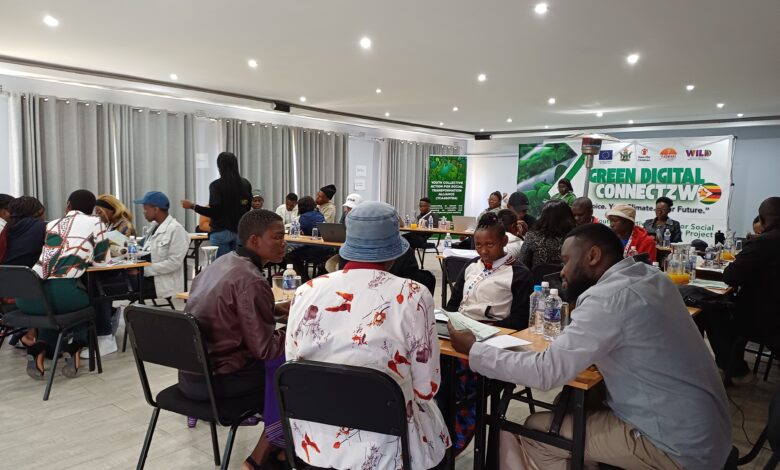
Currently participating in a 3-day green jobs bootcamp hosted by the Women’s Institute of Leadership and Development (WILD) in partnership with SAYWHAT, Save the Children and funded by the European Union, young people have come to appreciate the importance of connectivity in promoting green skills.
In the face of growing climate challenges and economic hardship, green entrepreneurship is emerging as a pathway to sustainable livelihoods. However, the potential of young people and marginalized communities to participate in this transition often depends on their ability to connect to information, mentorship, digital tools and markets. This realization has empowered young people to have an appreciation of how inclusive connectivity can play an important role in unlocking these opportunities.
Commending WILD for providing a space where young people can connect, one of the participants, Tawanda Nyambuya shared that it is important for young people to mingle and connect with people from different backgrounds in order to tap into their resources.
“It is important for young people to connect and network with people from different backgrounds as this will give us strength in terms of our customer sphere. For example, here we are having people from Gwanda, Binga, and from Bulawayo, and already I have been asking my colleagues from Binga what resources are there and what potential customers I may get, and they also get some customers from where I’m from,” he said, further adding that such platforms are necessary to build cooperatives or consortiums amid the current funding dynamics.
“When we link together and connect, we can actually fuse together and form one company which is stronger as we will have different characters with different skills. At the end of the training, we might have some cooperative or some consortiums that we will form and will actually strengthen us to apply for bigger grants. I might not be capacitated to apply a grant of US $200 000, but when we are a consortium, it becomes justifiable,” he said.
Another participant, Thubelihle Roslyn Ndlovu, a climate justice activist understood connectivity as a vehicle for exposure, creation of networks, and one that facilitates knowledge sharing to ensure that everyone, including those from remote communities is interconnected.
“As young people we now know what is happening in Binga and we are able to connect with them and see how best we can actually do our projects together. The connection that we have had with others has been inspiring because it gives us a different perspective to life,” she said.
Additionally, Thubelihle highlighted the need to have platforms where young people from all parts of the country and the world meet to share ideas and talk about what is happening in their spaces.
“We can have regional youth hubs and national youth networks that young people can subscribe to. For example, if we have young people in Masvingo or Binga interested in climate action, they can form their own youth hubs. These can be used to help ensure that as young people we can connect and have a network so that we speak in a collective voice,” she said, further highlighting that this can be done in a hybrid approach to bridge the digital divide.
Muziwanele Ncube, the chairman of Deep Plough, an award-winning cooperative encouraged young people attending such platforms to treat them as places of coordination and connections and to ensure that they research about everyone participating in such events as that is where their next opportunity could come from.
“That connection that is coming from Beitbridge, that connection that is coming from Matobo can be a life changing opportunity. There is a need that when young people come for bootcamps they profile everyone that is there and spend time researching what they are doing. You see gaps. You will see that as much as you have a concept, you can discover opportunities that are better by interacting with someone. Creating time to interact with other young people can be good for your concepts, and sometimes interactions are just as important because that’s where concepts can be identified,” he said.
In the age of digital platforms, connectivity for young people also mean that they can have access to information and education through online learning platforms, digital libraries and resources. They can collaborate and network with people across borders, access digital tools for green solutions and also have an opportunity to foster environmental awareness and action. However, there remains a huge internet gap as only 38% of the Zimbabwean population is online.
“Where I come from in Maphisa, we are facing a challenge of the digital gap. A lot of young people are not connected on the internet, they do not know what’s happening around the world, they do not have access to opportunities that are available because they do not have access to internet,” shared one of the green jobs boot camp, Sandra Annacletta Moyo, who further proposed a solution to this challenge.
“Here, we learnt how we can cover the digital divide by providing internet which is solar powered, like Starlink, and training the people there on digital literacy, digital advocacy, and how to use digital tools like AI, ChatGBT for their benefit,” she said.
Another participant, Wayne Musingwini, from Beitbridge also highlighted that there is an opportunity to bridge the knowledge gap.
“It’s not all youths who have the privilege or the knowledge of understanding these issues that are affecting them on a daily basis. We would like to go out there and teach and educate other youths about what these problems are and also to bridge the gap of linking them to what opportunities lie in these very same problems that they are facing on a day-to-day basis,” she said, further adding that young people should leverage on digital and social media platforms like LinkedIn, Facebook, and Google.
Hydroponics entrepreneur, Ntombifikile Ncube also discouraged young people from keeping information to themselves, highlighting that it can also be another avenue to make it grow, or even to earn from it, all the while contributing to inclusive resource sharing platforms.
“As young people we don’t like sharing information because people will be saying everything that I learnt is mine alone. But you can actually make money from sharing information. If you want to know something right now, go to YouTube and say how to do this, you will get it. You can also create your own channel and start teaching and making money from social media. We must use our data very wisely. You can’t spend all your day on TikTok and not learn anything at the end of the day,” she said.